Beyond Bland: Raising Adventurous Little Eaters
I introduce new seasonings in small amounts, paired with flavors my daughter already knows. Warm spices and sweet smoked paprika give us plenty to explore without chile heat. When I use chile, I start with a small amount and adjust future meals based on her response.
At The Clever Counter, we use Food Bridges to connect unfamiliar ingredients with a dish, flavor, or shape a child already knows. In this article the bridge is a flavor. Something already familiar on the plate, like rice, melted cheese, or a little citrus, does the reassuring, so a new spice has a chance to be tasted.
The American Academy of Pediatrics encourages flavor variety from early on. Its parenting site suggests including a little bit of spice among a baby’s first foods, alongside different textures and smells. The recipe sequence below is how we apply that idea in our kitchen.
Flavor first, heat optional
“Spicy” gets used for two different things. One is flavor: warm, earthy, smoky, aromatic. The other is heat, the burn that comes from chile peppers. A dish can have plenty of the first and very little of the second.
That distinction is the whole strategy. Most of the spices that make food interesting carry no heat at all, so a toddler can explore plenty of them without chile at all.
- Cumin, coriander, turmeric, cinnamon: warm, earthy, aromatic. No chile heat.
- Sweet smoked paprika: deep and smoky. No chile heat.
- Kashmiri chili powder: red color and warmth. Some heat; usually sold as a milder chili powder.
- Chipotle powder: smoky, from dried smoked jalapeños. Yes, it has heat; strength varies by brand and amount.
Check the label on smoked paprika, because hot smoked paprika exists too and does contain chile heat. How hot any chile powder tastes depends on the brand, the amount, and the child. Our pantry article covers which spices are worth keeping on hand.
Our recipe starting points
These recipes offer several starting points, not steps every child needs to complete. They are tested recipes from our own kitchen, grouped by type of seasoning, not by a measured heat level. Each one pairs the new flavor with something familiar.
- Warm spices, no chile. One Pot Biryani-Style Chicken and Rice, with cumin, coriander, turmeric, cinnamon and cardamom; familiar partners are rice, coconut milk and raisins. Or One Pot Shawarma Chicken and Rice, paired with rice, clementine and raisins.
- Smoke, no chile heat. Sweet Potato Mac & Cheese Sauce, with ¼ tsp sweet smoked paprika; the familiar partner is mac and cheese.
- A small amount of chile. Sheet Tray Chops, with ¼ tsp Kashmiri chili powder, optional, across a whole batch of patties; the familiar partner is a small patty to hold.
- Chile in a creamy marinade. Kati Roll-Style Chicken, with ½ tsp Kashmiri chili powder in a coconut-cream marinade; familiar partners are coconut cream, potatoes and peas.
- Smoke with a small amount of chile. Slow Cooker Chipotle Honey Beef, with ¼ tsp chipotle powder across 2 lb of beef; familiar partners are honey, clementine and butter.
There is no schedule and no finish line. Some children enjoy chile early, some prefer warm spices and smoke for a long time, and some never enjoy heat at all, which is true of adults too.
Putting it into practice: Slow Cooker Chipotle Honey Beef
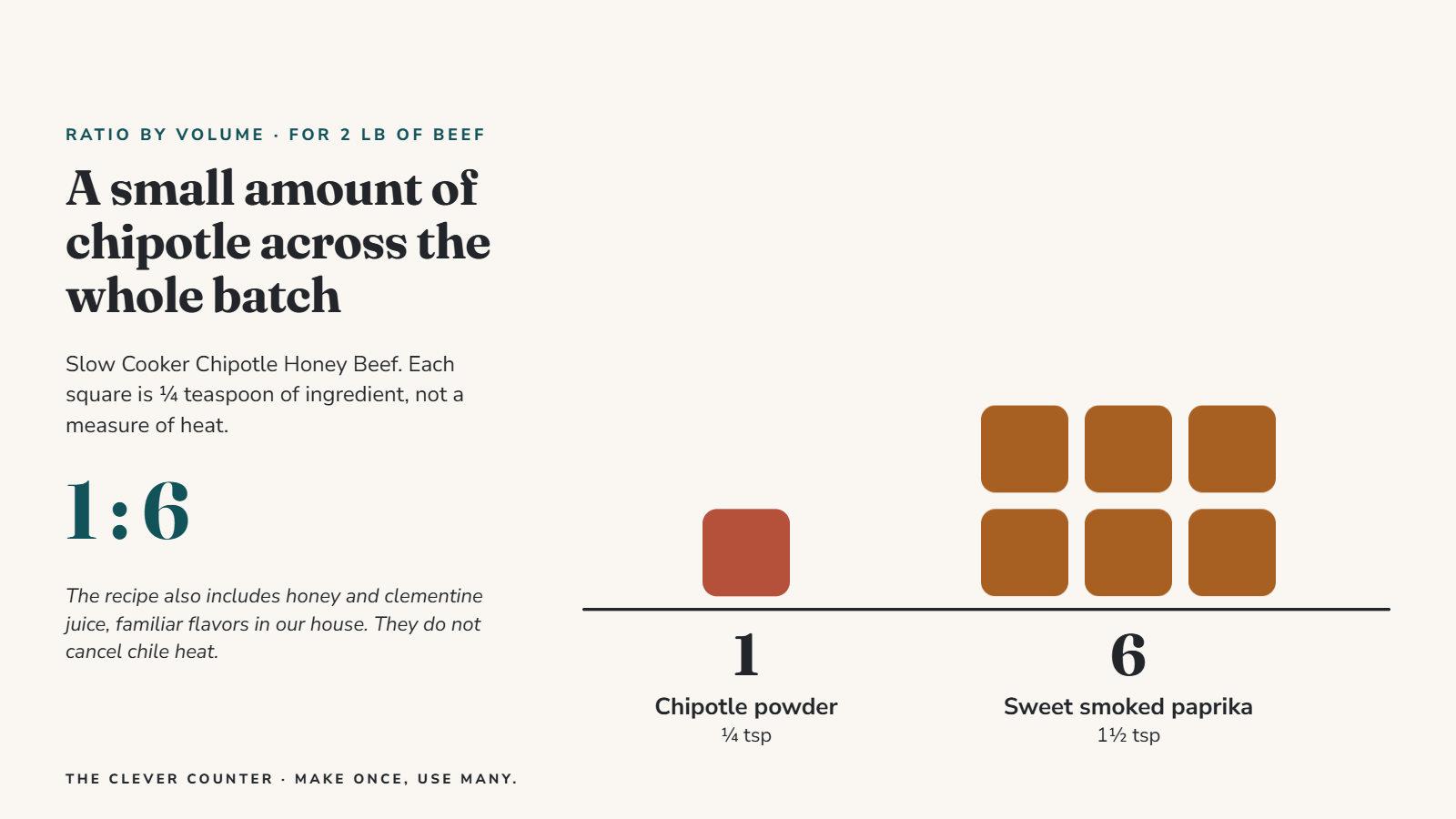
Our Slow Cooker Chipotle Honey Beef is the recipe we use when we include chile. What I pay attention to is not one ingredient but the ratio between two of them: chipotle powder and sweet smoked paprika.
The ratio: 1 : 6
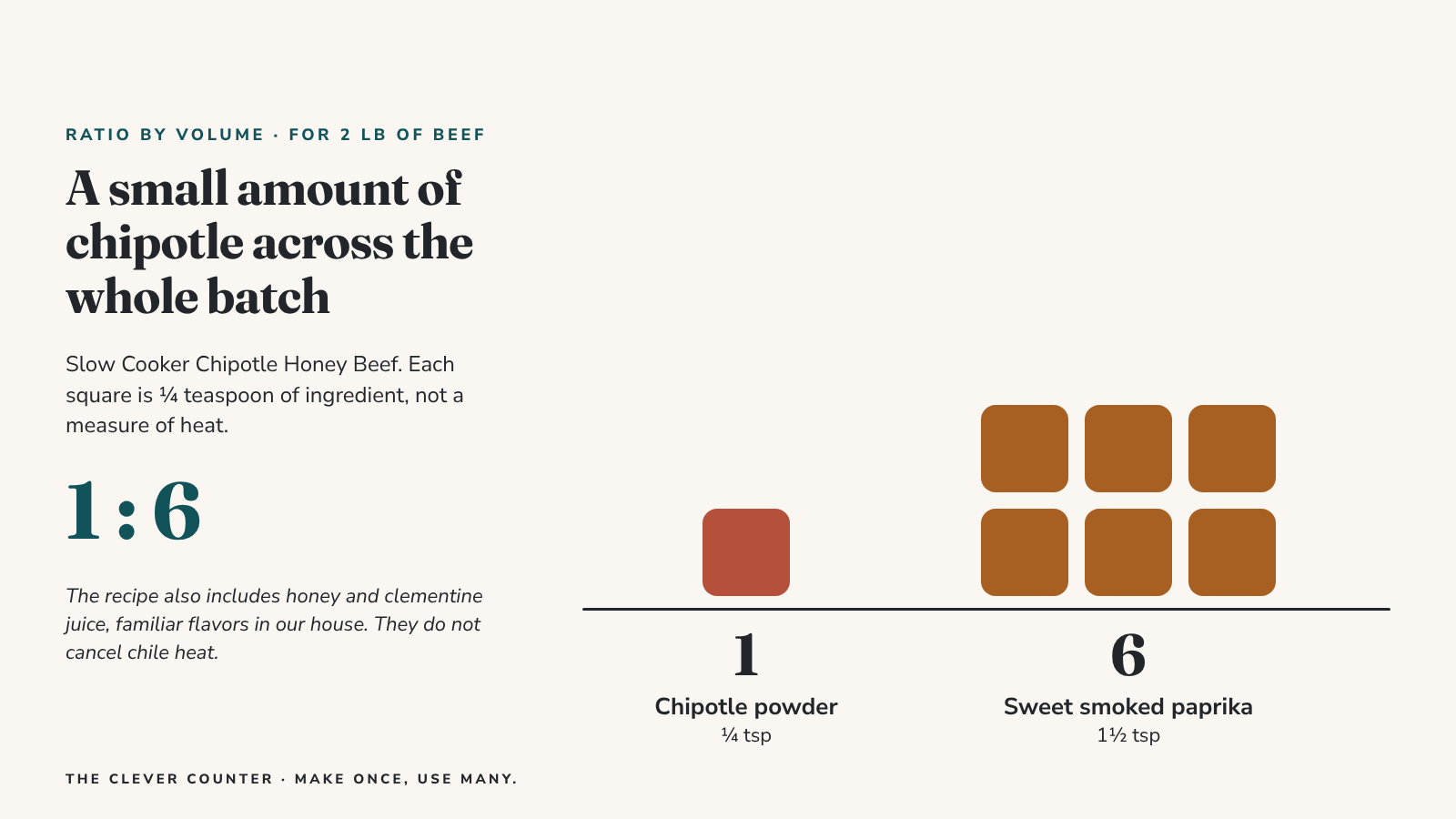
- Chipotle powder: ¼ tsp in the recipe. 1 part.
- Sweet smoked paprika: 1½ tsp in the recipe. 6 parts.
By volume, there are six parts of sweet smoked paprika for every part of chipotle, so the smoky flavor leads. Across 2 pounds of beef, that is ⅛ teaspoon of chipotle per pound. This is the amount I used in our tested recipe. Chile powders vary, and your child may experience the heat differently.
This recipe also includes 3 tablespoons of honey and the juice of two clementines, added at the end. In our house those are familiar flavors, so the chipotle arrives alongside something my daughter already knows. They do not cancel chile heat.
The ratio is also what to keep if you change the batch. Double the beef, and double both spices along with the rest of the ingredients.
It is one pot for the whole family. Nothing is cooked separately for the toddler.
When I served it, my daughter ate it happily, with no “Spicy! Bleh!”
Starting gentler
If you would rather start gentler, or skip chile entirely, there are two options:
- Leave the chipotle out. The smoked paprika still carries the smoky flavor.
- Start at ⅛ teaspoon. I have made it this way too. That halves the chipotle and changes the ratio to 1 : 12, with twice as much smoked paprika for every part of chipotle.
Serving it to a toddler safely
- Not for babies under 12 months. This recipe contains honey, and the CDC advises no honey before 12 months.
- Shred it finely. The CDC lists tough or large chunks of meat among potential choking hazards for young children. Pull the beef into small, tender pieces and adapt them to your child’s eating skills.
- Check for allergens. The sauce contains soy sauce, which usually includes wheat, and butter.
Small tastes, many times
New flavors work like new foods. The AAP notes that a toddler may need to taste a food 10 or more times before accepting it, and another AAP article puts the number of tries as high as 15 to 20.
So the goal is many small, calm tastes rather than one big success. Offer a small amount beside something familiar. You can invite your child to taste it, without making a bite a requirement. If they decline, move on and offer it again another day.
Every child is different. Some stay sensitive to strong flavors for a long time, and that is fine. If your child has reflux or another medical concern, ask your pediatrician before adding heat.
The recipe: Slow Cooker Chipotle Honey Beef
Ingredients
- 2 lb boneless stewing beef (brisket, chuck roast, etc.), cubed
- 1½ cups chopped cauliflower (can be omitted or swapped for other vegetables)
- 3 tbsp honey
- ¼ tsp chipotle powder (or ⅛ tsp, or leave it out, for a gentler start)
- 1½ tsp sweet smoked paprika (not hot)
- ½ tsp garlic powder
- ½ tsp onion powder
- 1 tsp cumin
- ¾ tsp salt, divided (½ tsp for the beef, ¼ tsp for the slow cooker)
- 1 tbsp rice vinegar (can substitute another vinegar)
- 1 tsp soy sauce
- ½ cup beef stock
- 1 tbsp butter
- 1½ tsp cornstarch + 1½ tbsp water
- Juice of 2 clementines
Instructions
- Season beef with ½ tsp salt. Brown beef for 2–3 minutes per side over medium-high heat.
- While the beef is browning, add honey, spices, vinegar, soy sauce, ¼ tsp salt, and stock to the slow cooker. Mix to combine.
- Add beef and cauliflower to the slow cooker. Lightly turn the beef to coat.
- Cook on low for 8–9 hours or on high for 5–6 hours.
- Remove beef from the slow cooker and shred with a fork. Return shredded beef to the slow cooker. Break up any softened cauliflower into the meat.
- Turn the slow cooker to high, uncovered. Add butter, cornstarch slurry, and clementine juice. Cook for another 5–10 minutes until the sauce thickens.
See the system in a real week.
Our free three-day guide, One Batch, Three Dinners, shows how one batch of cooking becomes several family meals, with toddler portions worked out.
Check your inbox. Your free guide is on its way.