Solving the Picky Eater Puzzle
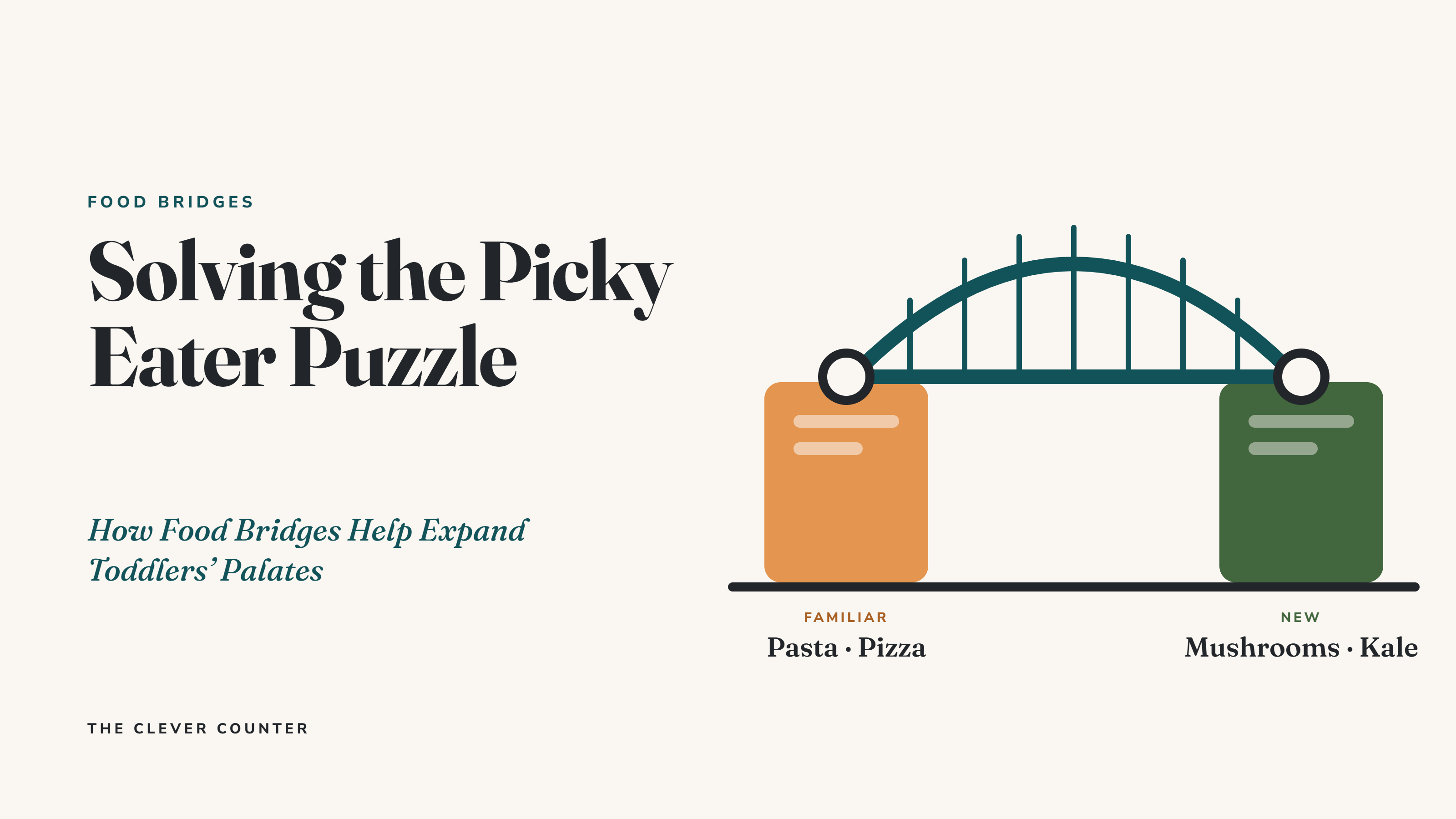
If your toddler eats pasta happily and treats a mushroom like a personal insult, you don’t need to cook a second dinner. You need a bridge. A Food Bridge uses something your toddler already knows, such as a dish, a flavor or a shape, to put something unfamiliar within reach, with no pressure and nothing hidden.
That is the short answer to “how do I get my toddler to try new foods?” Keep offering the new food, in small amounts, inside a meal that already feels safe, and let your child decide whether to eat it. The rest of this article shows how we do that at The Clever Counter with one batch of mushrooms and kale.
What a Food Bridge is, and what it isn’t
At The Clever Counter, we use Food Bridges to connect unfamiliar ingredients with a dish, flavor, or shape a child already knows. The familiar thing does the reassuring. The new food just gets to be on the plate.
A Food Bridge is not a trick. We don’t disguise what is in the food or rename it. If the sauce is green because it is made of kale, we say so.
It is also not a guarantee. Some bridges get crossed on the first try. Some take weeks. Some foods your child may simply never like, which is true of adults too.
Why repeated offers matter
Picky eating is usually a normal stage. The American Academy of Pediatrics notes that many children begin to reject unfamiliar foods somewhere between 18 months and 2 years old, and that a toddler may need to taste a food 10 or more times before accepting it. Another AAP article puts the number of tries as high as 15 to 20.
Their practical advice is consistent: offer small amounts, don’t make a fuss when a food is refused, and offer it again another day.
That is a lot of servings of something that may end up on the floor. So the real puzzle is not the first bite. It is how to keep putting the same new food on the table, in forms worth eating, without cooking it from scratch every time.
That is a meal-planning problem, and it is the one our system was built for.
Three kinds of bridges
- Format Bridge: a dish they already eat (pasta, pizza, a quesadilla) carries a new ingredient. Example: Mushroom & Kale Pesto Pasta, below.
- Flavor Bridge: a taste they already like (mild sweetness, melted cheese) carries a new seasoning. Example: Beyond Bland.
- Form-Factor Bridge: a shape they already hold (a nugget, a patty) carries new ingredients and spices. Example: Beyond the Chicken Nugget.
This article is about the first kind.
One Base, two bridges: mushrooms and kale
At The Clever Counter, a Base is a foundational preparation you make once and turn into several different meals. We call the whole approach Make Once, Use Many.
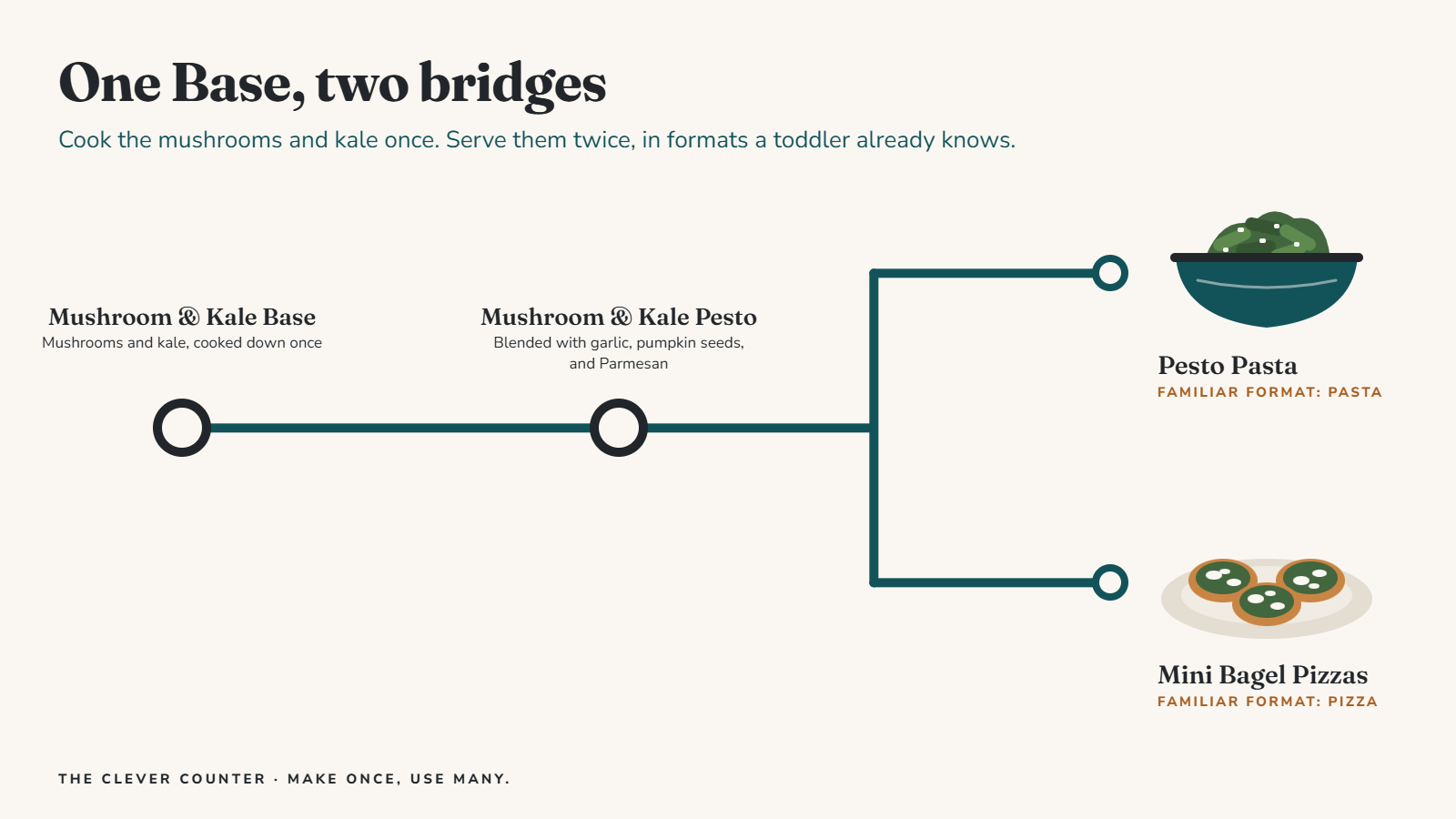
Our Mushroom & Kale Base is mushrooms and kale cooked down together: 1 lb of mushrooms and 12 oz of frozen kale for a batch of about 4 cups. Blend that with garlic, pumpkin seeds, and parmesan cheese, and now you have a pesto.
That pesto then shows up twice in two days, in two formats a toddler is likely to recognize.
Bridge 1: Mushroom & Kale Pesto Pasta
The familiar part is everything a toddler looks for in a pasta dinner: the shape, a sauce that clings, Parmesan on top. The new part is that the sauce is mushrooms and kale, and it is plainly green.
We loosen the pesto with a little pasta water so it coats rather than clumps. In our test week for one adult and one toddler, 1 cup of pesto covered dinner and the next day’s lunch.
When I served it, my daughter looked at the bowl and started eating. No drama, no negotiating. Anyone who feeds a toddler knows that counts as a major win.
Bridge 2: Mini Mushroom & Kale Pesto Bagel Pizzas
The next day, the same pesto goes onto mini bagels with mozzarella. Now the familiar part is pizza: melted cheese, something to pick up, a size made for small hands.
Each mini bagel takes 1 to 2 tablespoons of pesto. In the air fryer they take 5 to 7 minutes at 350°F; in the oven, 8 to 10 minutes at 375°F. Serve them right away.
The bagel pizzas went the same way: one look, and she started eating.
The AAP suggests pairing a bitter vegetable with something salty, such as broccoli with grated cheese. Kale under mozzarella works on the same idea.
- Pesto pasta: familiar format is pasta with sauce. New foods: mushrooms and kale. Pesto used: 1 cup for dinner plus next-day lunch, for 1 adult and 1 toddler.
- Bagel pizzas: familiar format is pizza. New foods: mushrooms and kale. Pesto used: 1 to 2 tablespoons per mini bagel.
- Cook the mushrooms and kale again? No, for either meal. Both use the prepared pesto.
Two meals, two exposures to mushrooms and kale, and the vegetables were cooked once. Leftover pesto keeps 3 to 4 days in the refrigerator or 2 to 3 months in the freezer, so the third and fourth offers are already made.
A bridge from my own table
I have watched the same pattern with a different sauce. My daughter had not really eaten tomato-based sauce. I served our white bean marinara over a pasta she already loved. She initially refused it. I asked her to try a small bite, and that was all it took. She gave me the coveted “Yummy in my tummy!” and I relaxed knowing she was going to eat a filling and nutritious dinner.
That was our experience with one meal. It is the pattern I look for when planning others: a familiar food gives a new ingredient a chance.
How to build a bridge at dinner tonight
- Choose a new ingredient or combination to introduce.
- Pick a format your toddler already accepts. Pasta, pizza, a quesadilla, rice, toast.
- Be open about what is in the food. If the pesto contains mushrooms and kale, call it mushroom and kale pesto.
- Serve a small amount beside something safe. A tablespoon of the new sauce on a few pieces of pasta counts.
- You can invite them to taste it, without making a bite a requirement. If they decline, move on and offer it again another day.
- Offer it again in a different format within the week. This is where a Base earns its keep.
The CDC advises preparing food to the right shape, size, and texture for your child’s development. For these bagel pizzas, adapt the pieces and texture to your child’s eating skills.
A flexible pantry makes step 6 much easier.
When a bridge isn’t enough
Food Bridges are a way to make ordinary picky eating a little easier to live with. They are not a treatment. Talk to your pediatrician if your child eats only a handful of foods, is not growing as expected, often gags or chokes, or if mealtimes have become distressing.
Try it this week.
The Mushroom & Kale Base, the pesto, the pasta and the bagel pizzas are all in our free three-day guide, One Batch, Three Dinners, with quantities, a grocery list and a prep plan..
Check your inbox. Your free guide is on its way.